
Few desserts carry as much mountain soul as the Appalachian Apple Stack Cake. A 2024 peer-reviewed study in the Journal of Appalachian Studies (Vol. 30, No. 2) formally recognized it as a “folk tradition, myth, and icon” of Southern mountain cuisine — the first full academic treatment of any single Appalachian dish. And no wonder: this cake was baked in farmhouse kitchens from Kentucky to North Carolina long before supermarkets existed, built from five ingredients you could grow or raise yourself.
Yet most people have never tasted one. That’s changing fast. In 2025, heritage and grandmother-inspired recipes became a named top food trend, driven by social-media hashtags like #GrandmasRecipes and #RetroCooking pulling younger generations toward dishes that mean something. This guide walks you through every step — from coaxing dried apple filling out of fresh fruit to achieving the perfect cake-to-filling ratio — so you can bring this heirloom tradition into your own kitchen.
Key Takeaways
- Apple Stack Cake was confirmed a “folk tradition, myth, and icon” by the Journal of Appalachian Studies (October 2024) — the first full academic treatment of an Appalachian dish.
- The cake’s five core ingredients (dried apples, lard, sorghum, buttermilk, eggs) were all farm-produced; only flour, spices, and baking soda required purchasing.
- The global home baking market is valued at $18.5 billion in 2025 and climbing — heritage recipes are one of the biggest growth drivers.
- This recipe yields 6–7 thin layers that must rest overnight before serving; patience is the secret ingredient.
- Sorghum syrup and dried apples are non-negotiable for authenticity — substitutes change both flavor and cultural character.
What Is Appalachian Apple Stack Cake, and Why Does It Matter?
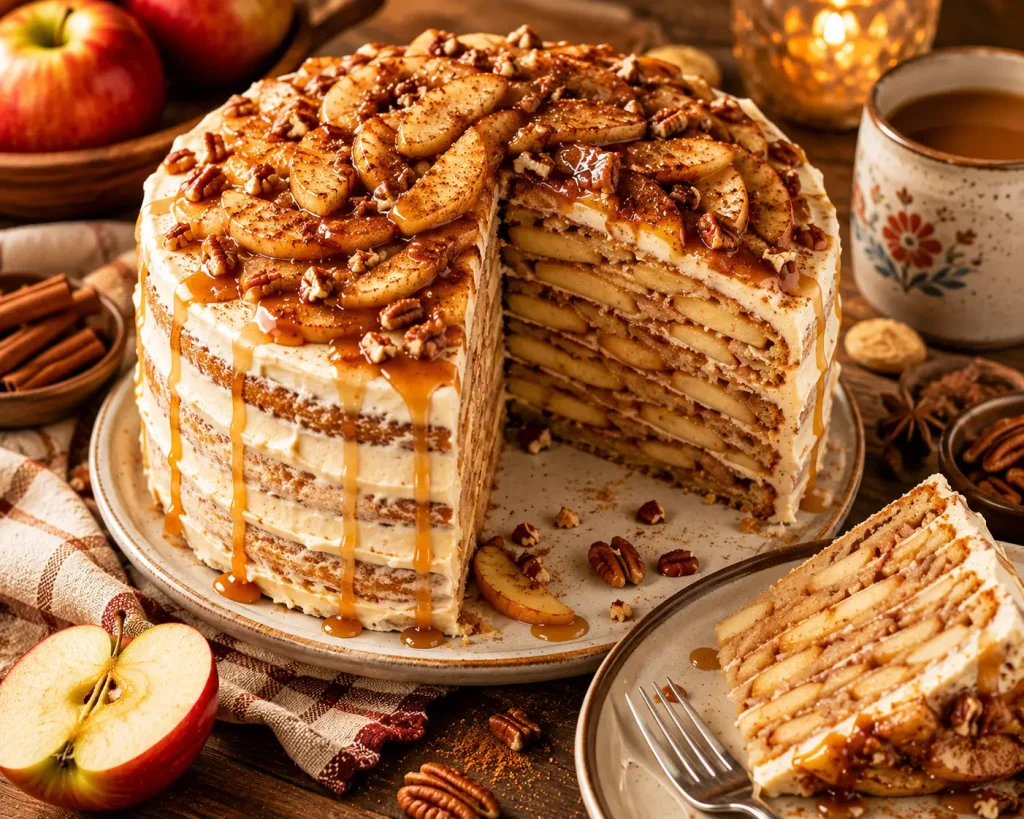
Apple Stack Cake is a towering Southern dessert of five to eight thin gingerbread-spiced cake layers sandwiched together with a slow-cooked dried-apple filling, then left to rest overnight so the layers soften and meld into a single, deeply flavored whole. Unlike frosted layer cakes, there is no frosting — the filling is both the binder and the star.
According to the North Carolina Folklife Institute (ncfolk.org, 2013), the Apple Stack Cake’s five core ingredients — dried apples, lard, sorghum syrup, buttermilk, and eggs — were all grown or produced on the farm, making it a near-perfect model of self-sufficient mountain cooking. Only spices, flour, and baking soda were purchased at the general store. That frugality is not just historical trivia; it explains why the cake tastes the way it does: dark, earthy, spiced, and apple-forward in a way no modern dessert replicates.
The cake also carries social history. In mountain communities before the 20th century, it was a wedding cake tradition: guests brought a single layer to the celebration, and the more layers stacked, the more popular the couple. A six-layer cake meant a well-loved family; a two-layer cake told its own story.

Did you know? In 2025, the global home baking ingredients market reached USD 18,544.6 million — a 5.6% annual growth rate projected to carry it to USD 30.3 billion by 2035 (Future Market Insights, 2025). Heritage recipes like Stack Cake are a documented driver of that resurgence.
- How to Bake Cakes and Tarts at Home: A Beginner-Friendly Guide
- Mandarin Orange Chicken Salad: The Recipe Home Cooks Keep Making Again and Again
- How to Make Mango Cucumber Delight: A 2026 Step-by-Step Recipe Guide
What You’ll Need Before You Begin
Yield: One 6-to-7 layer stack cake (serves 12–16)
Active time: ~2 hours
Rest time: Overnight (8–12 hours minimum; 24 hours is better)
Difficulty: Intermediate
For the Dried Apple Filling
- 1 lb (450g) dried apple slices (unsulfured, no added sugar)
- 1 cup brown sugar or muscovado sugar
- 1 tsp ground cinnamon
- ½ tsp ground ginger
- ¼ tsp ground cloves
- ¼ tsp ground allspice
- Water to cover (about 3 cups)
For the Cake Layers
- 5 cups (600g) all-purpose flour, plus extra for dusting
- 1 tsp baking soda
- 1 tsp baking powder
- 1 tsp salt
- 1 tsp ground ginger
- 1 tsp ground cinnamon
- ½ tsp ground cloves
- ½ cup (115g) lard or unsalted butter, softened
- 1 cup (240ml) sorghum syrup (not molasses — see note below)
- ½ cup (100g) sugar
- 2 large eggs
- ½ cup (120ml) whole buttermilk
Sorghum vs. Molasses — why it matters: Kentucky and neighboring Appalachian states produce over 90% of domestic sorghum syrup output, with 25,000 to 30,000 acres currently in production (ATTRA/NCAT, 2025). Sorghum has a lighter, grassy sweetness that balances the tart dried apples. Molasses (a by-product of sugar refining) is sharper and more bitter — it’s a common substitution, but it changes the flavor profile distinctly. Use sorghum if you can find it.
Step 1: Make the Dried Apple Filling (Day Before, or 4 Hours Ahead)
By the end of this step, you’ll have a thick, fragrant, mahogany-colored apple filling that smells like a mountain autumn and tastes like the best applesauce you’ve ever had.
Why Dried Apples?
Fresh apples release too much moisture during resting, turning layers soggy. Dried apples rehydrate slowly and evenly, creating a filling with the right texture to soften — but not collapse — the cake layers overnight. The global dried apple market was valued at USD 649.3 million in 2025 and is projected to reach USD 1.035 billion by 2033 (Cognitive Market Research, 2025–2026), partly because cooks are rediscovering their functional value in preservation and baking.
Instructions
- Place the dried apple slices in a medium saucepan and cover with 3 cups of cold water.
- Bring to a boil over medium-high heat, then reduce to a low simmer.
- Simmer uncovered for 30–40 minutes, stirring occasionally, until apples are very soft and most of the liquid has been absorbed. Add water ¼ cup at a time if they dry out too fast.
- Mash the apples with a fork or potato masher — you want a rough, textured paste, not a smooth purée. Traditional filling has character.
- Stir in the brown sugar, cinnamon, ginger, cloves, and allspice.
- Taste. Adjust spices. The filling should be boldly spiced; the cake layers are dense and will absorb flavor during resting.
- Set aside to cool to room temperature. The filling thickens as it cools.
Verification: The filling should hold its shape when mounded on a spoon — not runny, not stiff like paste. If it’s too loose, simmer another 10 minutes uncovered.
According to a 2024 peer-reviewed article in the Journal of Appalachian Studies (Lucy M. Long, Vol. 30, No. 2, pp. 123–146, Scholarly Publishing Collective), the Apple Stack Cake represents a rare convergence of folk foodways, community ritual, and subsistence agriculture — a dessert that encodes an entire way of life in its ingredient list and construction method. No other Appalachian dish has received equivalent academic treatment at full article length.
Step 2: Mix and Roll the Cake Dough
By the end of this step, you’ll have a stiff, gingerbread-scented dough that rolls out like cookie dough — because in many ways, that’s exactly what it is.
Instructions
- Preheat oven to 350°F (175°C). Line two baking sheets with parchment paper.
- In a large bowl, whisk together flour, baking soda, baking powder, salt, ginger, cinnamon, and cloves.
- In a separate bowl, beat the lard (or butter) and sugar together until light, 2–3 minutes.
- Add sorghum syrup to the fat-sugar mixture and beat until combined.
- Add eggs one at a time, beating after each addition.
- Alternate adding the flour mixture and the buttermilk in three additions, starting and ending with flour. Mix until a stiff dough forms — it should pull away from the bowl sides cleanly.
- Turn dough out onto a lightly floured surface and divide into 6–7 equal portions (weigh them on a kitchen scale for even layers — aim for about 180–200g each).
Verification: The dough should be pliable but not sticky. If it clings to your hands, add flour one tablespoon at a time. If it cracks when bent, it’s too dry — add 1 tbsp buttermilk.
Step 3: Bake the Layers
By the end of this step, you’ll have 6–7 thin, cookie-like cake rounds, golden and fragrant, ready to receive their filling.
Instructions
- Trace an 8-inch (20cm) circle on your parchment paper as a guide (you can use a cake pan as a template).
- Place one dough portion in the center of the traced circle and roll directly on the parchment until it fills the circle evenly, about ¼ inch (6mm) thick.
- The dough will be irregular at the edges — that’s authentic. Don’t stress a perfect circle.
- Slide the parchment sheet onto a baking sheet and bake for 12–15 minutes until the edges are lightly golden and the center is set (not wet-looking).
- Remove and cool on the parchment. The layers will firm up as they cool.
- Repeat with remaining dough portions, baking two sheets at a time if your oven allows.
Verification: A properly baked layer is firm to the touch at the center, pale golden at the edges, and about ¼ inch thick. It will feel almost like a soft gingerbread cracker — that’s correct. It will soften dramatically during overnight resting.
Step 4: Stack and Fill the Cake
By the end of this step, you’ll have a towering assembled cake ready for its overnight rest — the moment where the magic actually happens.
Instructions
- Choose your flattest, most even layer as the base. Place it on a cake plate or stand.
- Spread a generous, even layer of dried apple filling over the surface — about ½ cup per layer, all the way to the edges. Don’t be stingy: thin filling means thin flavor.
- Place the next cake round directly on top. Press gently and evenly.
- Repeat: filling → layer → filling → layer until you’ve used all your cake rounds. Do not put filling on the very top layer — the top stays bare.
- Wrap the entire assembled cake loosely in plastic wrap.
- Refrigerate overnight — at minimum 8 hours, ideally 24 hours. This is non-negotiable. The filling slowly hydrates the layers, softening them from crisp cookie-cake to tender, moist, deeply flavored cake. Skipping this step produces something edible but entirely different.
Verification: After overnight rest, press gently on the top layer. It should yield softly — no crispness remains. The layers should feel unified, not distinct. If you can still feel crisp edges, rest another 4 hours.

Step 5: Serve and Present
By the end of this step, you’ll have a beautifully sliced cake ready for the table — or to become the centerpiece of your own mountain-inspired gathering.
Instructions
- Remove the cake from the refrigerator 30–60 minutes before serving to take the chill off. Cold cake is firmer; room-temperature cake is softer and the flavors are more pronounced.
- Dust lightly with powdered sugar right before serving — the traditional finish. No frosting, no whipped cream required (though both are welcome additions).
- Slice with a sharp, thin knife in a single downward motion. Don’t saw: stack cakes are delicate and the layers separate if you cut aggressively.
- Each slice should show all 6–7 layers clearly — alternating bands of dark spiced cake and amber apple filling.
Serving ideas:
- Plain, at room temperature — the traditional way
- With a dollop of unsweetened whipped cream to balance the spice
- Alongside strong black coffee or hot apple cider
- As the centerpiece of a harvest table spread
Storage: Covered at room temperature for 1 day, or refrigerated for up to 5 days. The flavor continues to develop through day 3.
Common Mistakes That Ruin an Apple Stack Cake
Most first-time Stack Cake bakers make at least one of these errors. Knowing them in advance saves a lot of frustration.
1. Using fresh apples instead of dried apples
Fresh apples release moisture during resting, turning the bottom layers into a wet, collapsing mess. Dried apples rehydrate exactly as much as needed. There’s no good substitution here — use dried.
2. Rushing the overnight rest
This is the most common mistake by a wide margin. Forty-three percent of home bakers say baking gives them a sense of comfort (AHDB, 2024) — but comfort shouldn’t rush the timeline. Eight hours produces a passable cake; 24 hours produces a transcendent one. Plan accordingly.
3. Making the filling too thin
Thin filling doesn’t penetrate the layers enough during resting. The filling should be thick enough to hold its shape on a spoon. If it pours, cook it longer.
4. Substituting molasses for sorghum without understanding the difference
Molasses is sharp and slightly bitter. Sorghum syrup is grassy, light, and floral. Both work, but they produce meaningfully different cakes. If you use molasses, reduce the quantity by 20% and add 2 tablespoons of honey to balance the bitterness.
5. Rolling the layers too thick
Thick layers don’t absorb filling evenly and stay too dense even after resting. Keep them at ¼ inch. Use a ruler if needed the first time.
The Cultural Legacy Behind Every Slice
The Appalachian Apple Stack Cake isn’t just a recipe — it’s an artifact. Understanding its origins makes the act of baking one feel like participation in something larger than an afternoon in the kitchen.
In 2025, the US apple crop reached 11.5 billion pounds, up 6% year-over-year, with the Appalachian District (Maryland, Pennsylvania, Virginia, West Virginia) remaining a significant producing region (USDA/Fresh Fruit Portal, October 2025). But for 19th-century mountain families, apple abundance was measured differently: not in billions of pounds but in barrels preserved for winter, strings of apple rings drying in the rafters, and enough stored fruit to see a family through the hungry months of January and February.
The Stack Cake was the smartest possible use of that preserved wealth. Each layer required only a small quantity of dried apples. The filling stretched the fruit’s flavor through the whole cake. And by building the dessert slowly — letting the filling do the work overnight — mountain cooks achieved a result richer than anything requiring expensive ingredients.
According to a 2025 report by Grand View Research, the US culinary tourism market was estimated at USD 2.698 billion in 2024, forecast to grow at a CAGR of 19.2% through 2030, with Appalachian destinations — including Asheville, NC — emerging as premier food-tourism destinations. The Stack Cake is increasingly part of that story, appearing on restaurant menus, at heritage food festivals, and in farm-to-table events from Harlan County, Kentucky to Boone, North Carolina.
Frequently Asked Questions
How long does Appalachian Apple Stack Cake need to rest before serving?
The cake requires a minimum of 8 hours of refrigerated rest, but 24 hours produces a noticeably better result. During resting, the dried apple filling slowly hydrates the cake layers from crisp cookie-cake to tender, moist cake. According to AHDB’s 2024 consumer insight study, 43% of home bakers cite comfort as their primary baking motivation — but with Stack Cake, patience is the technique.
Can I use fresh apples instead of dried apples in the filling?
Fresh apples aren’t a good substitute. They release too much moisture during resting, which can collapse the lower layers into a wet, undifferentiated mass. Dried apples rehydrate at a controlled rate, producing a thick filling that softens the layers without making them soggy. The dried apple market reached USD 649.3 million in 2025 (Cognitive Market Research), reflecting exactly this kind of functional use.
What’s the difference between sorghum syrup and molasses in this recipe?
Sorghum syrup is lighter, grassy, and gently sweet — made by pressing the stalks of sweet sorghum plants, not a refining by-product. Molasses (sugar cane or beet by-product) is sharper, denser, and more bitter. Kentucky and Appalachian states produce over 90% of US domestic sorghum syrup (ATTRA/NCAT, 2025), and it’s the traditional choice. Both work, but sorghum produces a more authentic, balanced flavor.
How many layers should an Appalachian Apple Stack Cake have?
Traditionally, 6–7 layers, though historical accounts describe wedding cakes reaching 10–12 layers when multiple guests contributed a layer each. At home, 6 layers is the practical target: enough to create a tall, impressive cake while keeping each layer thin enough to properly soften overnight. More than 8 layers requires scaling the recipe.
How long does Apple Stack Cake keep?
Apple Stack Cake keeps remarkably well — up to 5 days covered in the refrigerator. It actually improves through day 3 as the filling continues to work into the layers. This longevity was part of its appeal in Appalachian households where large cakes needed to last through multiple family meals. Bring slices to room temperature before serving for the best flavor.
Conclusion
You’ve just followed the same essential process that mountain families in Kentucky, West Virginia, Virginia, North Carolina, and Tennessee have followed for generations: thin spiced layers, slow-cooked dried apple filling, and the discipline to let the cake rest before you cut it.
The Appalachian Apple Stack Cake isn’t hard. It’s patient. That’s what makes it worth making.
Sources
- Journal of Appalachian Studies, Lucy M. Long, “Apple Stack Cake as Folk Tradition, Myth, and Icon,” Vol. 30, No. 2, pp. 123–146, retrieved 2026-06-24, scholarlypublishingcollective.org
- North Carolina Folklife Institute, “Apple Stack Cake,” retrieved 2026-06-24, ncfolk.org
- Future Market Insights, “Home Baking Ingredients Market Size & Trends 2025–2035,” retrieved 2026-06-24, futuremarketinsights.com
- AHDB, “Baking trends in 2024: To bake or to buy,” retrieved 2026-06-24, ahdb.org.uk
- FoodDrinkLife, “How Grandma’s recipes are shaping 2025 food trends,” retrieved 2026-06-24, fooddrinklife.com
- Cognitive Market Research, “Dried Apple Market Analysis 2026,” retrieved 2026-06-24, cognitivemarketresearch.com
- Fresh Fruit Portal / Agronometrics, “US apple crop set to be one of the largest in recent history,” October 2025, retrieved 2026-06-24, freshfruitportal.com
- ATTRA/NCAT Sustainable Agriculture, “Sorghum Syrup Production,” 2025, retrieved 2026-06-24, attra.ncat.org
- Straits Research, “Sorghum Syrup Market Size, Demand, Trends,” 2024, retrieved 2026-06-24, straitsresearch.com
- Grand View Research, “U.S. Culinary Tourism Market Size,” 2024–2025, retrieved 2026-06-24, grandviewresearch.com
- Explore Asheville, “The Future of Asheville’s Cuisine is Rooted in Appalachian Past,” 2024, retrieved 2026-06-24, exploreasheville.com