
Every summer, one drink takes over social media — and in 2026, it’s Brazilian Lemonade all over again. You’ve probably scrolled past the creamy, jade-green glasses on TikTok and Pinterest a dozen times. But what exactly is it, and why can’t people stop making it?
Here’s the thing: Brazilian Lemonade isn’t technically made with lemons, and it isn’t technically a lemonade. It’s a blended lime drink enriched with sweetened condensed milk, and it comes together in under five minutes with four ingredients. The global lemonade market is projected to hit $13.57 billion in 2026 (Mordor Intelligence, 2026), and a huge driver of that surge is exactly this kind of fresh, viral, home-blendable drink.
This guide walks you through the authentic recipe, the science behind why you can’t over-blend, and the variations worth trying — including a lighter coconut milk version for those watching sugar intake.
Key Takeaways
- Brazilian Lemonade (Limonada Suíça) uses limes, not lemons — “limão” means lime in Portuguese.
- The global lemonade market reaches $13.57 billion in 2026, with viral blended drinks fueling home consumption (Mordor Intelligence, 2026).
- Blend for no more than 10–15 seconds to avoid releasing bitter compounds from the lime peel.
- A single serving delivers 16–31 mg of Vitamin C and 112–259 mg of calcium (SnapCalorie, 2025).
What Is Brazilian Lemonade (And Why Is It Called That)?
In 2026, Limonada Suíça is enjoying a second viral moment — because once people taste it, they don’t stop making it. Brazilian Lemonade, known in Brazil as Limonada Suíça (Swiss Lemonade), is a blended beverage made from whole limes — peel and all — combined with ice, cold water, sugar, and sweetened condensed milk. It’s simultaneously tart, sweet, and velvety in a way that regular lemonade simply isn’t.
The name confusion runs deep. In Portuguese, limão refers to lime, not lemon. So when Brazilians say limonada, they mean a lime-based drink. The “Swiss” in the name comes from the sweetened condensed milk, which was first imported to Brazil and popularized by Nestlé — a Swiss company that began local production in Brazil in 1921 (Wikipedia, Swiss Lemonade, 2025). The drink is believed to have originated in the state of Minas Gerais, where street vendors first blended limes with condensed milk and ice.
The result is a drink unlike anything in the Western lemonade tradition: cloudy, creamy, and intensely lime-forward. It went viral on TikTok because it looks dramatic and impressive, yet takes under five minutes to make.
According to Brazilian Kitchen Abroad, the drink’s rise outside Brazil tracks directly with increased access to sweetened condensed milk in American supermarkets — now a staple ingredient in most international food aisles.
According to market data, in 2026 the global lemonade market is projected to reach $13.57 billion, up from $12.51 billion in 2025 (Mordor Intelligence, Lemonade Market Size Report, 2026). Home-blended viral drinks like Brazilian Lemonade are a core growth driver, as consumers seek restaurant-quality beverages without the restaurant markup.
What Ingredients and Equipment Do You Need?
This recipe is genuinely fast, but a little prep makes it perfect. Here’s what to have ready:
Ingredients (serves 2):
- 3–4 Persian limes (unwaxed preferred, organic if possible)
- 1 cup cold water
- 1–2 tablespoons granulated sugar (adjust to taste)
- ½ cup sweetened condensed milk
- 2 cups ice cubes
Equipment:
- Blender (a standard countertop blender works fine)
- Fine mesh strainer or cheesecloth
- Large pitcher or two tall glasses
- Sharp knife and cutting board
Time: Under 5 minutes | Difficulty: Beginner | Yield: 2 generous servings (~16 oz each)
Why organic limes? You’re blending the peel. Wax coatings and pesticide residues on conventional limes end up in your drink. Scrub conventional limes thoroughly with a produce brush under cold running water if organic aren’t available.
Step 1: Prep Your Limes (Don’t Skip This)
By the end of this step, you’ll have lime quarters ready to blend — with all bitter pith minimized. The most important prep detail nobody talks about: cut off both ends of each lime before quartering. The white pithy tips at the stem and blossom ends concentrate bitterness. Removing them makes a measurable difference in the final flavor.
- Wash limes thoroughly under cold running water.
- Slice off approximately ¼ inch from both the top (stem) and bottom (blossom) ends of each lime.
- Quarter each lime lengthwise into 4 wedges.
- Remove any visible seeds (they add bitterness when blended).
Verification: You should have 12–16 lime wedges, with the flat ends cleanly trimmed. The cut flesh should look bright green with white pith visible on the edges — that’s normal and expected.
Step 2: Blend — But Time It Carefully
By the end of this step, you’ll have a frothy, pale green liquid that smells intensely of fresh lime. Here’s the single most critical technique in the entire recipe: don’t over-blend. The lime peel contains aromatic oils that release flavor quickly — but continued blending also releases bitter compounds from the white pith. The sweet spot is 10 to 15 seconds maximum, as confirmed by multiple Brazilian cooking resources including Kevin Is Cooking and The Modern Nonna.
- Add the lime quarters to the blender.
- Pour in the cold water.
- Add the granulated sugar.
- Blend on high for exactly 10–15 seconds. Set a phone timer.
- Stop the blender immediately when the timer goes off, even if it looks like it could blend more.
Verification: The mixture should look cloudy green and frothy. You’ll smell a strong, bright lime aroma. If the mixture smells more bitter than fresh, you blended too long — unfortunately, there’s no fix for this batch, but now you know.
Pro tip: Cold water is non-negotiable. Room temperature water causes the ice to melt faster and dilutes the drink before you’ve even served it. Chill your water in the fridge for 30 minutes before making this.
Step 3: Strain the Mixture
By the end of this step, you’ll have a smooth lime liquid free of pulp and peel fragments.
- Place a fine-mesh strainer over a large pitcher or bowl.
- Pour the blended lime mixture through the strainer.
- Use the back of a spoon to press and stir the pulp, extracting as much liquid as possible.
- Discard the strained solids (peel, pulp).
Verification: The strained liquid should be pale green and slightly cloudy — not chunky. If it’s too thick to pour easily, add 2–3 tablespoons of cold water and stir.
Step 4: Add the Condensed Milk and Ice
By the end of this step, you’ll have the finished drink — creamy, cold, and ready to serve. This is where the magic happens. Sweetened condensed milk doesn’t just add sweetness; its thick, emulsified texture coats the tart lime liquid and creates that signature velvety mouthfeel.
- Pour the strained lime liquid back into the blender (or directly into glasses).
- Add ½ cup of sweetened condensed milk.
- Add 2 cups of ice cubes.
- Blend briefly for 5 seconds — just enough to incorporate and chill.
- Taste and adjust: add more sugar if you want it sweeter, more condensed milk for creaminess, more water to thin.
Verification: The drink should be pale creamy green, uniformly mixed, and cold to the touch. Serve immediately — Brazilian Lemonade doesn’t hold well. The lime oils continue to interact with the dairy proteins, and the flavor shifts within 15–20 minutes of blending.
Serving tip: Pour over fresh ice in tall glasses. Garnish with a lime wheel or slice. Serve with a wide straw, since the drink can be thick.
Which Variations Are Worth Trying?
Brazilian Lemonade is infinitely adaptable. In 2026, as 30–40% of new Brazilian lemonade products carry reduced-sugar or no-added-sugar claims (compared to ~15–20% in 2020, IndexBox, 2025), lighter versions have exploded in popularity.
Coconut Milk Version (Dairy-Free): Substitute the sweetened condensed milk with ½ cup full-fat coconut milk plus 2 tablespoons of maple syrup or agave. The result is lighter and tropical, with a subtle coconut undertone. Recipe inspiration: Healthy Little Vittles.
Sparkling Brazilian Lemonade: Replace the cold water with sparkling water (added after blending, not in the blender). Stir gently to preserve carbonation. This version is closer to a lime soda-cream hybrid.
Frozen Brazilian Lemonade (Sorbet-Style): Freeze the blended and strained lime liquid in ice cube trays, then blend the frozen lime cubes with condensed milk. The result is a slushie-thick frozen drink that doesn’t dilute.
Spiked Limonada: Add 2 oz of cachaça (Brazilian sugarcane spirit), white rum, or vodka per serving before the final blend. Cachaça keeps the drink most authentic to its Minas Gerais roots.
What Are the Most Common Brazilian Lemonade Mistakes?
Most first-timers get tripped up on two things. The most frequent error — over-blending — ruins roughly half of first attempts, based on feedback across major food blogs including The Recipe Critic and Budget Bytes. Here’s the full mistake list:
1. Blending too long. The mistake: running the blender for 30–60 seconds because the mixture looks unblended. Why it happens: people apply normal blending logic (more = smoother). The fix: set a timer for 15 seconds and stop. The drink doesn’t need to be completely smooth — it gets strained.
2. Using bottled lime juice instead of fresh limes. The mistake: substituting bottled lime juice to save time. Why it happens: convenience. The fix: don’t. The aromatic oils in the lime peel are the entire flavor profile. Bottled juice has no peel, and the drink tastes flat and artificial without it.
3. Skipping the straining step. The mistake: pouring the blended mixture straight into glasses. Why it happens: impatience. The fix: always strain. Peel fragments in the drink are unpleasant and add bitterness with every sip.
4. Serving it too late. The mistake: making the drink 30 minutes before guests arrive. Why it happens: wanting to prep ahead. The fix: make Brazilian Lemonade to order, or at most 10 minutes before serving. After 15–20 minutes, the lime continues oxidizing in the dairy, the color grays slightly, and the flavor sharpens unpleasantly.
5. Using room-temperature water. The mistake: using tap water straight from the faucet. Why it happens: not thinking about it. The fix: use refrigerator-cold water. The entire drink needs to be ice-cold from the start, since the blending process adds friction heat.
How Do You Know Your Brazilian Lemonade Turned Out Right?
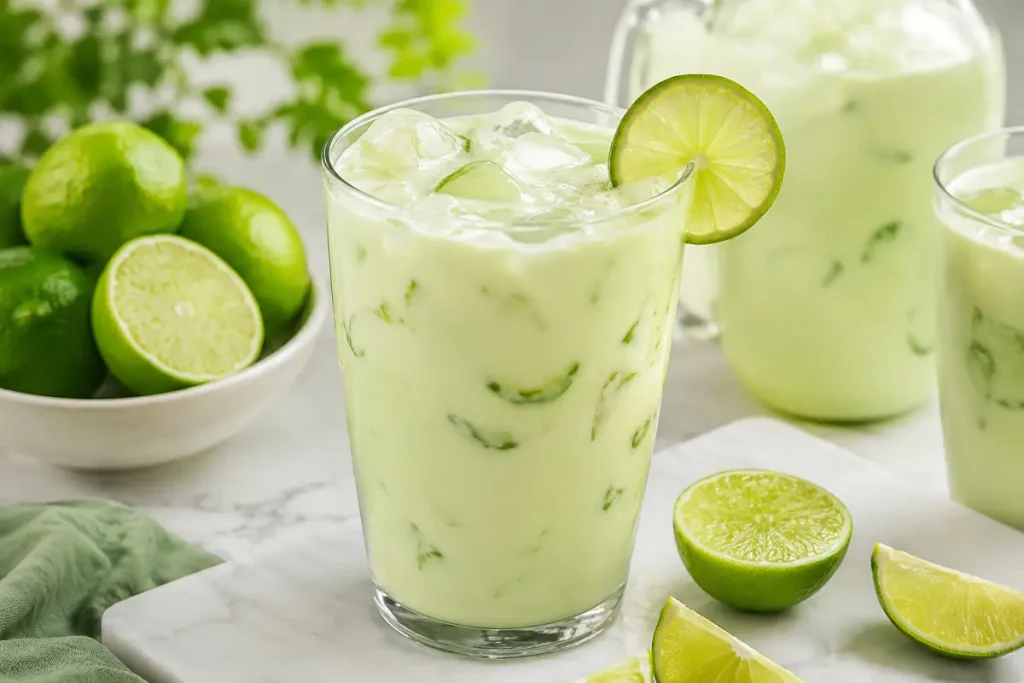
If everything went correctly, you’re holding a tall glass of something that’s pale creamy green, intensely aromatic, ice cold, and frothy at the top. The flavor hits sour and tart first, with the condensed milk rounding it out into something sweeter and velvety in the finish.
Nutritionally, a 16 oz serving delivers:
- 230–310 calories (varies by condensed milk quantity used)
- 42–55g sugar (primarily from condensed milk)
- 112–259mg calcium — a meaningful contribution from the condensed milk
- 16–31mg Vitamin C from the fresh lime juice
(SnapCalorie Nutritional Database, 2025)
If you want a lower-sugar version, the coconut milk substitution reduces sugar content by approximately 30–40%, in line with the broader trend toward reduced-sugar alternatives that now represent 30–40% of new Brazilian lemonade product launches (IndexBox, 2025).
- How to Make Whipped Pink Lemonade: A 2026 Step-by-Step Guide
- How to Make a Vanilla Raspberry Iced Latte: A 2026 Step-by-Step Guide
Frequently Asked Questions
Why is Brazilian Lemonade made with limes instead of lemons?
In Portuguese, the word limão refers to lime, not lemon. So limonada (lemonade) in Brazil means a lime-based drink. The specific lime used is the Persian lime (limão-taiti, or Tahitian lime), which is the standard small green lime sold in most grocery stores worldwide. The name “lemonade” is simply a translation artifact.
Can I make Brazilian Lemonade without condensed milk?
Yes — substitute full-fat coconut milk plus 2 tablespoons of maple syrup or agave nectar for a dairy-free version that’s also lower in sugar. The texture is slightly lighter and less creamy, but the lime flavor comes through just as strongly.
How long does Brazilian Lemonade last?
It doesn’t keep. Brazilian Lemonade is best consumed within 10–15 minutes of blending. The lime oils continue to react with the dairy proteins and the drink becomes more bitter and changes color after about 20 minutes. Make it fresh, per serving if possible.
Can I use key limes instead of Persian limes?
You can, but the result is significantly more tart and floral. Key limes are smaller and more acidic, so you’d use fewer — roughly 6–8 key limes instead of 3–4 Persian limes. The bitterness risk from over-blending is also slightly higher with key limes due to their thinner peel-to-juice ratio.
Is Brazilian Lemonade the same as a caipirinha?
No — a caipirinha is a cocktail made with cachaça, muddled lime, sugar, and ice (no dairy, no blending). Brazilian Lemonade is a non-alcoholic blended drink that happens to use similar ingredients. You can combine them by adding cachaça to Brazilian Lemonade for a “limonada spiked,” but they’re distinct drinks with different textures and preparations.
Conclusion
Brazilian Lemonade is one of those recipes that sounds more complicated than it is. Four ingredients, a blender, and 15 seconds of hands-on effort — that’s genuinely all it takes to make a drink that people assume came from a restaurant. The hard part isn’t the recipe; it’s trusting that such a short blend time is enough. It is.
Now that you’ve got the technique down, try the coconut milk version on your next run, or go full Minas Gerais tradition with a shot of cachaça for something truly special.
Sources:
- Mordor Intelligence, Lemonade Market Size Report
- IndexBox, Brazil Lemonade Market Analysis
- SnapCalorie, Brazilian Lemonade Nutrition
- Wikipedia, Swiss Lemonade
- Brazilian Kitchen Abroad, Brazilian Lemonade Recipe
- Kevin Is Cooking, Brazilian Lemonade (Limonada)
- Healthy Little Vittles, Coconut Milk Brazilian Lemonade
- The Recipe Critic, Brazilian Lemonade (Limeade) Recipe
- Budget Bytes, Brazilian Lemonade
- Tasting Table, What Is Brazilian Lemonade And Why Is It Made With Limes?