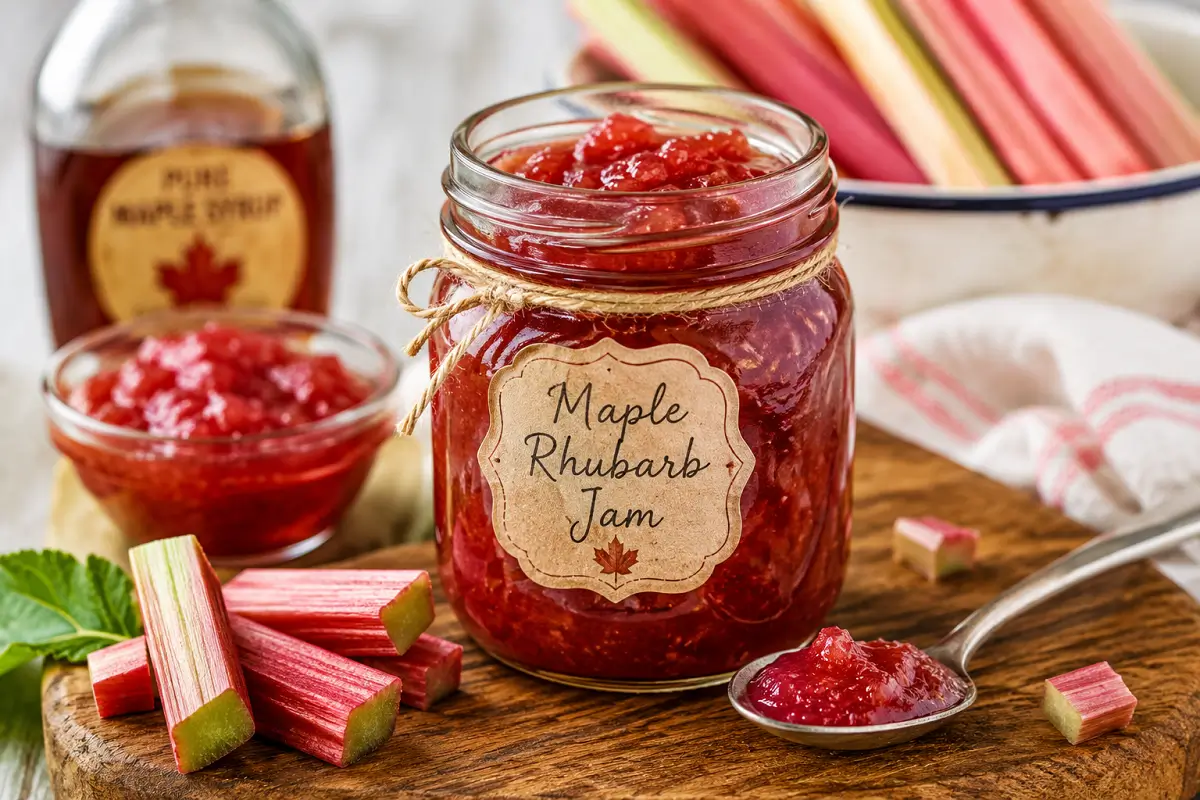
Make maple rhubarb jam with a spicy ginger kick in under 1 hour. Small-batch recipe using pure maple syrup instead of refined sugar — artisan quality at home.
Key Takeaways
- The global specialty jam market reached USD 10.2 billion in 2025, with artisan small-batch preserves driving a 22% demand surge (Future Data Stats, 2025).
- Maple syrup replaces refined sugar in this recipe — over 80% of consumers are willing to pay a premium for natural-ingredient preserves.
- This small-batch recipe yields 3 half-pint jars and takes under 1 hour from prep to sealed jar.
- Fresh ginger and a pinch of cinnamon add the “spicy” dimension that makes this jam stand out on a cheese board or breakfast table.
Why Maple Syrup Makes Better Rhubarb Jam
In 2025, the global maple syrup market reached USD 1.68 billion in value, with a projected CAGR of 6.6% through 2034 as consumers increasingly swap refined sugars for natural alternatives (Market.us, 2025). That consumer shift isn’t just a trend number — it tastes better, too.

Refined sugar gives rhubarb jam sweetness but nothing else. Maple syrup gives sweetness plus a caramel, woodsy depth that layers beautifully with rhubarb’s natural acidity. Grade A Dark Robust maple syrup (formerly Grade B) is ideal here — its stronger flavor holds up during cooking rather than fading into the background.
The practical swap: maple syrup is roughly 67% as sweet as sugar by volume, so you’ll use slightly more to achieve the same jam sweetness. This recipe is calibrated for that ratio. The result sets properly and won’t be cloying.
For a deeper look at which sweeteners work best in preserves, see our guide to maple syrup varieties and culinary uses.
What You Need: Ingredients and Equipment
Small-batch preserving doesn’t require a canning arsenal. Approximately 1 in 4 U.S. households already engage in some form of food preservation (PickYourOwn.org), and most have what this recipe needs.
Ingredients (yields 3 half-pint / 8 oz jars)
| Ingredient | Amount | Notes |
|---|---|---|
| Fresh rhubarb, chopped | 4 cups (about 500g) | Trim leaves — they’re toxic |
| Pure maple syrup | 1¼ cups | Grade A Dark Robust preferred |
| Fresh ginger, grated | 1½ tsp | More for extra heat |
| Ground cinnamon | ¼ tsp | Pinch only — don’t overpower |
| Lemon juice, fresh | 2 tbsp | Adds pectin and balances sweetness |
| Vanilla extract (optional) | ½ tsp | Rounds the flavor |
Equipment Checklist
- Heavy-bottomed saucepan (3-quart minimum)
- Wooden spoon or silicone spatula
- Jar lifter or tongs
- Three 8 oz (half-pint) mason jars with new lids
- Wide-mouth funnel (optional but helpful)
- Candy thermometer or cold-plate test setup
- Large stockpot for water-bath canning (if shelf-stable storage is goal)

Quick note on pectin: Rhubarb is naturally low in pectin, but lemon juice provides enough when combined with high-sugar maple syrup and a slow cook-down. This recipe skips commercial pectin entirely — and the set is better for it: soft, spreadable, not rubbery.
Learn more about natural pectin sources in our guide to making pectin-free jams and preserves.
Step 1 — Prep and Macerate the Rhubarb (15 Minutes)
The maceration step is where flavor is born. Combining chopped rhubarb with maple syrup and letting it sit breaks down cell walls and draws out juice — you’ll see a ruby pool form within minutes. Skip this step and your jam will need longer cooking time and lose some of the vegetable’s brightness.
How to do it:
- Wash and dry rhubarb stalks. Remove all leaf material (rhubarb leaves contain oxalic acid and are toxic — don’t compost them near edible plants either).
- Chop into ½-inch pieces. You don’t need precision here; they’ll cook down completely.
- Combine rhubarb and maple syrup in a heavy saucepan. Stir briefly.
- Cover loosely and let sit at room temperature for 15 minutes. The syrup pulls moisture from the rhubarb, creating a head start on the jam’s liquid base.
Step 2 — Cook and Add the Spices (20 Minutes)
This is where “sweet rhubarb jam” becomes “sweet-and-spicy rhubarb jam.” Ginger is the star; cinnamon is the supporting actor. Both are added mid-cook so the heat blooms their oils without letting them dominate.
How to do it:
- Place the macerated rhubarb and all its pooled juice over medium-high heat. Bring to a rolling boil, stirring frequently to prevent scorching on the bottom.
- Add grated ginger and ground cinnamon after the first 5 minutes. The jam should be bubbling actively.
- Reduce heat to medium. Cook, stirring every 2–3 minutes, for another 15 minutes. The mixture will thicken visibly.
- Optional: add vanilla extract in the final 2 minutes. Don’t add it earlier — long heat exposure flattens vanilla’s aromatic complexity.
Watching the texture: As the jam reduces, the bubbles change character — from large, splashy eruptions to smaller, glazier-looking pops. That’s your visual signal that you’re close to the gel point.

According to a 2025 Future Data Stats Specialty Jam Market report, demand for artisanal jams and small-batch preserves rose 22%, especially among health-conscious urban consumers seeking bolder, more complex flavors beyond standard grocery-store varieties (Future Data Stats, 2025). A ginger-forward maple rhubarb jam sits squarely in that demand window.
For more on using ginger in preserves, see our guide to adding spices to homemade jams.
Step 3 — Test the Gel Set (5 Minutes)
The gel test determines whether your maple rhubarb jam is ready or needs another 5 minutes. Don’t skip it — jam that’s under-cooked pours like syrup; jam that’s over-cooked turns stiff and loses brightness.
The cold plate method (most reliable):
- Before you start cooking, place two small plates in the freezer.
- When the jam looks close (around the 18-minute mark), drop a teaspoon onto a frozen plate.
- Wait 30 seconds, then push the jam with your finger.
- If it wrinkles and holds its shape: it’s set. If it runs back together: cook another 3–5 minutes and test again.
The thermometer method (backup): Jam reaches gel point at 220°F (104°C) at sea level. Adjust down 2°F for every 1,000 feet of elevation.
Step 4 — Fill, Seal, and Store the Jars (10 Minutes)
For a small batch of three jars, you have two storage options: refrigerator jars (easiest, no processing needed) or water-bath canned jars (shelf-stable for up to 18 months).
Option A — Refrigerator jam (simplest):
- Wash jars in hot soapy water and rinse well.
- Pour hot jam into warm jars using a funnel. Leave ¼-inch headspace.
- Wipe rims clean. Apply lids. Let cool to room temperature.
- Refrigerate immediately. Use within 3 weeks.
Option B — Water-bath canning (shelf-stable):
- Sterilize jars by simmering in boiling water for 10 minutes. Keep warm until filling.
- Fill hot jars with hot jam. Leave ¼-inch headspace. Remove air bubbles with a skewer.
- Wipe rims. Apply new lids and rings to fingertip-tight.
- Process in a boiling-water canner for 10 minutes (adjust for altitude: +1 min per 1,000 ft above 1,000 ft elevation).
- Remove jars without tilting. Cool 12–24 hours undisturbed. Check seals — center of lid should not flex.

The global pressure canning market was valued at USD 4.99 billion in 2024, projected to reach USD 6.49 billion by 2034 at a CAGR of 3.9% — driven largely by the home-preserving resurgence among younger generations who want to control ingredients and reduce food waste (Intel Market Research, 2025).
Common Mistakes to Avoid When Making Maple Rhubarb Jam
Even experienced jam-makers run into these. Here’s what actually goes wrong — and how to fix it.
1. Watery jam that won’t set
Cause: Undercooking, or measuring maple syrup by weight instead of volume. Fix: Return the opened jars to the pan, reheat with 1 tbsp fresh lemon juice, and re-cook until the cold-plate test passes.
2. Scorched bottom
Cause: Insufficient stirring during the final 5 minutes when sugar concentration is highest. Fix: Use a heavy-bottomed pan and stir constantly once the jam thickens.
3. Jam that’s too sweet
Cause: Using a light maple syrup grade (Amber Rich or Golden Delicate). Fix: Use Grade A Dark Robust or add an extra ½ tbsp of lemon juice to counterbalance.
4. Sealed jars that re-open in storage
Cause: Overfilling (headspace less than ¼ inch) or under-processing. Fix: Always leave exactly ¼ inch of headspace and process for the full recommended time.
See our full guide to common jam-making problems and solutions for more fixes.
How to Use Maple Rhubarb Jam Beyond Toast
This jam has range. Don’t limit it to breakfast.
- Cheese board pairing: Outstanding with aged cheddar, manchego, or brie. The ginger-rhubarb tartness cuts through fat in a way that standard strawberry jam can’t.
- Glaze for pork or duck: Thin with a tablespoon of apple cider vinegar and brush onto meat during the final 10 minutes of roasting.
- Yogurt parfait: Swirl into plain Greek yogurt with granola.
- Vinaigrette base: Whisk 1 tbsp jam with 2 tbsp olive oil, 1 tbsp white wine vinegar, and a pinch of salt.
- Cocktail mixer: Stir 1 tsp into a gin and tonic or whiskey sour.
Explore more in our guide to using fruit preserves in savory cooking.
Watch: Rhubarb Jam Techniques
The Market Behind the Jar: Why Artisan Jam Is Booming
In 2025, the global specialty jam market reached USD 10.2 billion, and it’s on track to hit USD 16 billion by 2033 at a CAGR of 5.5% — driven by consumers done with corn-syrup-laden grocery-store spreads (Future Data Stats, 2025). The North American segment alone grew from USD 1.88 billion in 2024 and is projected to reach USD 2.5 billion by 2033 (ResearchAndMarkets via Yahoo Finance, 2025).
Over 70% of artisan jam and preserve brands reported double-digit growth in the 2024–2025 period (Market Research Future, 2025). The rhubarb market itself grew to USD 312.83 million in 2024, projected to reach USD 454 million by 2032 (360iResearch, 2025).
- How to Make Blueberry Fluff Salad: A Deliciously Light Dessert for Sweet Moments (2026)
- How to Make Firecracker Strawberry Lemonade Popsicles
Frequently Asked Questions About Maple Rhubarb Jam
Can I use frozen rhubarb to make maple rhubarb jam?
Yes — frozen rhubarb works well, and it often produces a better-colored jam because freezing breaks down cell walls and releases more anthocyanins (the red pigments). Thaw completely and drain excess liquid before cooking. Frozen produce retains 85–95% of its nutritional value when properly frozen, making it a reliable substitute for fresh in cooked applications (USDA food science resources).
How long does maple rhubarb jam last?
Refrigerator jam lasts 3 weeks when kept below 40°F. Water-bath canned jars last 12–18 months in a cool, dark pantry. Once opened, refrigerate and use within 3 weeks regardless of processing method. The National Center for Home Food Preservation recommends storing canned goods below 70°F for optimal shelf life and quality.
Why didn’t my jam set properly?
Rhubarb is naturally low in pectin, and maple syrup has higher water content than granulated sugar — which means the gel point can take longer to reach. Cook to a confirmed cold-plate set (not just time). If the jam is already jarred and too loose, open the jars, return jam to the pan, add 1 tbsp lemon juice, and re-cook for 8–10 minutes before re-jarring.
Can I reduce the maple syrup to make it less sweet?
You can reduce by up to 25% (to about 1 cup), but the set will be softer and shelf life shortened for water-bath processed jars. For refrigerator jam, reducing to ¾ cup is workable. The USDA cautions that reducing sugar in tested recipes by more than 25% affects the safety margin for water-bath canning.
What spices work in maple rhubarb jam besides ginger?
Cardamom pairs beautifully — use ¼ tsp ground. Black pepper (⅛ tsp) adds subtle heat without an identifiable spice flavor. Dried chili flakes (just a pinch) take this in a more savory direction that’s outstanding on a cheese board. Avoid star anise and cloves — they overpower rhubarb completely.
See our guide to spicing homemade jams and chutneys for the full breakdown.
Conclusion
Maple rhubarb jam with ginger isn’t complicated — it’s a 50-minute process with a recipe that actually works. The maple syrup substitution isn’t a health compromise; it’s a flavor upgrade. The ginger isn’t a gimmick; it transforms the jam into something you’ll want on a cheese board, in a cocktail, and brushed onto roast pork. Three jars. Under an hour. Ingredients you can buy at any grocery store during rhubarb season.
Key takeaways:
- Macerate rhubarb in maple syrup before cooking for better color and flavor
- Add ginger and cinnamon mid-cook to preserve aromatic complexity
- Use the cold-plate test — not just cooking time — to confirm gel set
- Grade A Dark Robust maple syrup outperforms lighter grades in cooked applications
- Both refrigerator and water-bath storage options work for this recipe
Make this while rhubarb is in season. If you want to take it further, try our complete seasonal rhubarb recipe guide or dive into our beginner’s guide to home canning safety.
Sources
- Future Data Stats, Specialty Jam Market Size & Industry Growth, retrieved 2026-06-27, https://www.futuredatastats.com/specialty-jam-market
- Market Research Future, Jam Jelly and Preserves Market Size, Trends, retrieved 2026-06-27, https://www.marketresearchfuture.com/reports/jam-jelly-preserves-market-26956
- Market.us, Maple Syrup Market Size & Share, Growth Trends 2034, retrieved 2026-06-27, https://market.us/report/maple-syrup-market/
- Intel Market Research, Pressure Canning Market Outlook 2026–2034, retrieved 2026-06-27, https://www.intelmarketresearch.com/pressure-canning-market-35092
- 360iResearch, Rhubarb Market Size & Share 2025–2032, retrieved 2026-06-27, https://www.360iresearch.com/library/intelligence/rhubarb
- PickYourOwn.org, Home Canning Statistics, retrieved 2026-06-27, https://www.pickyourown.org/home_canning_statistics.htm
- ResearchAndMarkets via Yahoo Finance, North America Jam, Jelly, and Preserves Market Report 2025–2033, retrieved 2026-06-27, https://uk.finance.yahoo.com/news/north-america-jam-jelly-preserves-160700044.html
 AuthorSarah TeamDifficultyBeginner
Make maple rhubarb jam with a spicy ginger kick in under 1 hour. Small-batch recipe using pure maple syrup instead of refined sugar — artisan quality at home.